Designing terminals for tomorrow’s operations
Key takeaways
- No two terminals are alike, effective terminal design starts with understanding the specific operational realities, local regulations, and ways of working of each individual site.
- Kalmar Terminal Design Services uses real operational data to build simulations and emulations, replacing months of manual calibration with faster, data-driven scenario testing.
- With experience from over 250 projects worldwide, Kalmar's approach helps operators make confident investment decisions on electrification, automation, or new terminal builds well before breaking ground.
Modernising terminal operations is becoming more and more crucial to operators all over the world. Environmental commitments, rising throughput demands, and increasing pressure on operational efficiency are forcing terminals to rethink how they operate.
But transformation, whether it involves electrification, automation, or establishing an entirely new terminal, is complex and holds a significant risk to operators. The decisions made early in the design phase shape everything that follows, from operational performance and throughput to total cost of ownership and long-term return on investment. This is exactly why those decisions must be grounded in the specific realities of each operation, not a generic blueprint.
Understanding the real operation
Effective terminal design starts with acknowledging that no two terminals are exactly alike. “We want to sit down with the experts running the show on site because there are a lot of variations and quite a lot of unique things to know, such as customs, customers, ways of working and local regulations that could change the whole setup,” explains Christopher Saavedra, Senior Sales Manager, Automation & Solutions Design at Kalmar.
This forms the foundation of Kalmar Terminal Design Services, where collaboration and shared insight are central to the process. “We want to involve the customer at every step of the process, even if it takes longer, because it adds more value when we shape the solution together,” says Saavedra. This approach also provides the operators with insights to ensure decisions are practical, well-informed, and grounded in real operational conditions.
We want to involve the customer at every step of the process, even if it takes longer, because it adds more value when we shape the solution together
Using data to guide decision making
A key part of the process is turning design concepts into testable, data-driven models. Using real operational data ensures forecasts reflect actual conditions of that specific terminal rather than assumptions.
Simulation for manual and electric operations
MyKalmar Insight data is used to build realistic simulations for conventional and electrified fleets. It's a capability that has evolved significantly. “We used to create simulation platforms from scratch, calibrating every detail and it could take months,” explains Saavedra.
The new, advanced tools have changed the equation entirely. “We are now able to do it much faster and based on actual customer data,” he notes. The process works by collecting operational data from a specific period and creating a baseline model. After that the scenarios can be rerun with modifications in order to understand the operational impact. "Operators are able to deploy charging stations and rerun that same scenario with an electric fleet to understand the impact of electrification," Christopher describes.
Operators are able to deploy charging stations and rerun that same scenario with an electric fleet to understand the impact of electrification
In electrification projects, the team also evaluates shift patterns, driving distances, traffic flows, and infrastructure limitations to create strategies that balance efficiency with energy use.
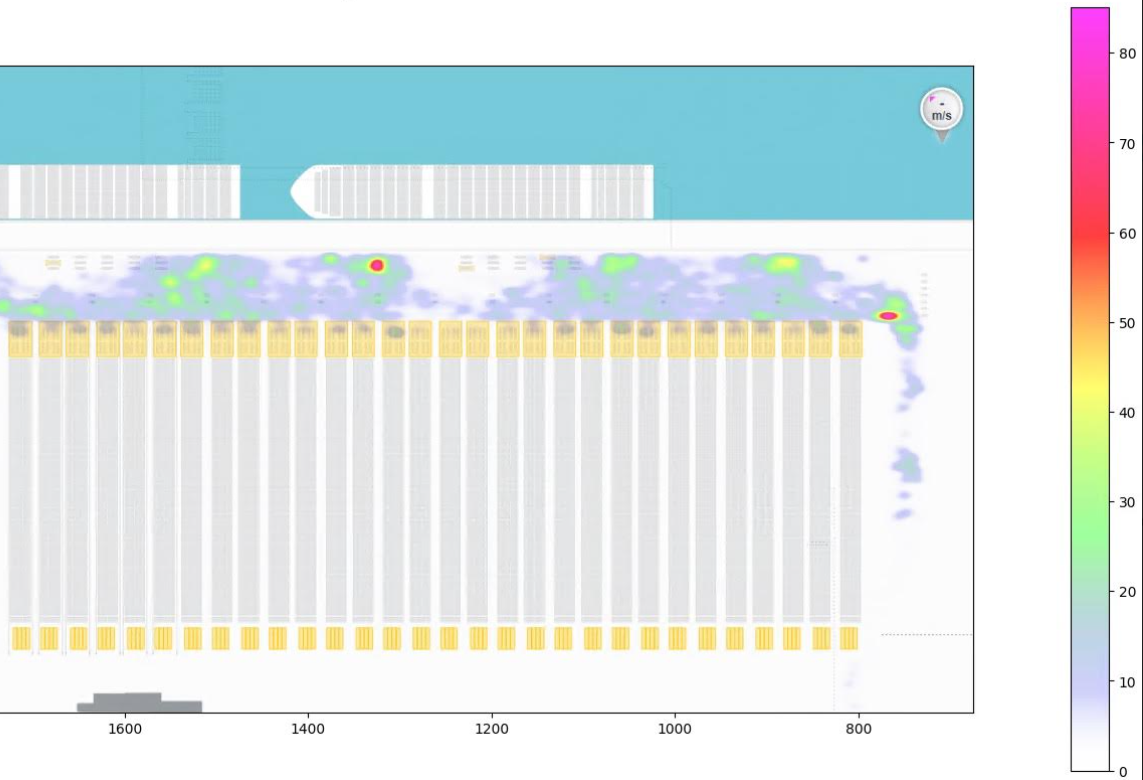
Driving patterns and traffic flow can be analysed using a heat map visualization.
Emulation for automation projects
For automation projects, emulation provides a more detailed approach. By using production software and verified simulators, operators can test performance, integration, and workflows in a realistic environment. This allows adjustments to layouts or equipment mixes before changes are implemented. With the Kalmar Scenario Modeller, new scenarios can be created quickly to see how different setups would perform with equipment like STS, AutoStrad, AutoRTG, ASC, AutoTT, or AGV.
Three steps to a validated design
The process follows three main phases, each building on the previous:
1. Investigate options
For new terminals or major redevelopments, the first step is exploring possibilities. High-level layouts are developed and assessed, with estimates of terminal capacity for each option. This helps operators understand which approach fits best with their business objectives.
2. Qualify design
After selecting a preferred option, the design is examined in more detail. Capacity calculations, fleet estimates, and a high-level project plan are created. A comprehensive business case is developed, covering CAPEX, OPEX, and ROI, helping operators make decisions with confidence.
3. Simulate, emulate and validate
Finally, designs are brought to life through simulation and emulation. We can also develop a so-called digital twin, a virtual model of the terminal that runs on the same production software as the real operation. With these tools, operators can test scenarios, evaluate performance, and make adjustments before committing to implementation. “We can’t rely on theory alone. Seeing how a terminal actually operates helps create solutions that will work day to day, not just on paper”, adds Christopher.
Seeing how a terminal actually operates helps create solutions that will work day to day, not just on paper
From insight to results
The value of terminal design services is shown in practice. “We recently worked with a customer where we combined simulation, operational analysis, and a clear business case into one package,” Saavedra explains. “We showed what their operations could look like with an electric fleet, at least for the first phase.” The result? Approval to move forward. Data-driven analysis, simulation, and transparent communication helped the operator make the decision with confidence.
We recently worked with a customer where we combined simulation, operational analysis, and a clear business case into one package
Preparing for the future
Terminal operators face increasing pressure to modernise, electrify, and automate their operations. The window for acting ahead of the curve is narrowing. Those who plan proactively protect their competitive position; those who hesitate risk being left behind.
Whether planning a greenfield site, converting an existing operation, or exploring electrification, today’s decisions will shape performance and profitability for decades. Kalmar Terminal Design Services brings the tools, expertise, and collaborative approach to make sure those choices are the right ones for your terminal.
With experience from over 250 projects worldwide, our team helps operators investigate options, qualify designs, and validate investments before breaking ground. All of this is done in close collaboration to ensure every aspect of the operations is carefully considered.

Related articles
Subscribe and receive updates in your email
Iscriviti alle nostre pubblicazioni